Work Is Changing Faster Than Buildings
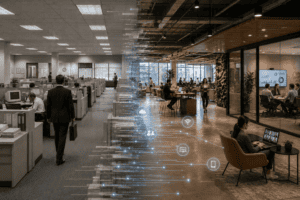
Buildings have always been designed with permanence in mind.
They are planned over months, constructed over years, and expected to serve organizations for decades. Long after the ribbon-cutting ceremony has ended, they continue supporting the people who occupy them—often through multiple leadership teams, changing business strategies, and evolving industries.
Work, however, no longer moves at the same pace.
The last decade has fundamentally reshaped how organizations collaborate. Hybrid work has blurred the distinction between physical and digital offices. Artificial intelligence is transforming routine tasks at a pace few predicted. Teams are more geographically distributed, more connected, and more dependent on technology than at any point in history.
The result is an increasingly important challenge for organizations: how do you create workplaces that remain relevant when the nature of work itself refuses to stand still?
The answer is not to predict the future perfectly. It is to design for uncertainty.
Buildings No Longer Define Work
For much of the twentieth century, the office dictated how people worked.
Employees gathered in assigned spaces because the work itself depended on physical proximity. Meetings happened around conference tables. Information lived in filing cabinets. Collaboration required everyone to be in the same room at the same time.
Today, those constraints have largely disappeared.
Work follows people rather than places. Employees transition seamlessly between home offices, client sites, airports, headquarters, and collaboration spaces. Meetings regularly include participants joining from multiple cities or continents. Information moves instantly between devices instead of remaining tied to a physical location.
Ironically, this has made the physical workplace more—not less—important.
The office is no longer the only place where work can happen. It must become the place that offers something work cannot easily replicate elsewhere.
The Most Valuable Offices Create Experiences
Organizations often ask how much technology should be included in a workplace.
A more useful question may be what kind of experience that workplace should create.
People rarely choose to commute because an office contains impressive displays or sophisticated infrastructure. They choose to come together because collaboration feels easier, conversations happen naturally, and ideas develop more effectively in person.
Technology should support those experiences rather than compete with them.
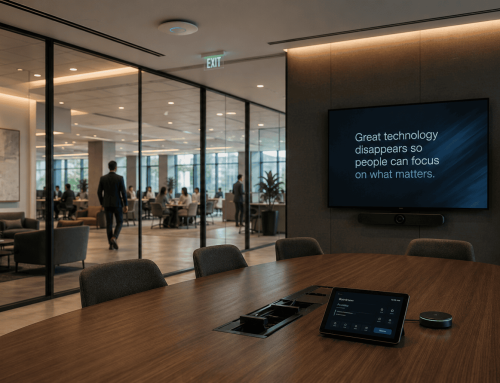
The most successful workplaces are not defined by the quantity of technology they contain, but by how naturally that technology enables people to connect, communicate, and create.
When infrastructure disappears into the background, people become the focus once again.
Flexibility Has Become a Design Principle
Perhaps the greatest change in workplace strategy is that flexibility is no longer considered a feature.
It has become a requirement.
No organization can confidently predict how work will evolve over the next decade. New collaboration platforms will emerge. Artificial intelligence will automate different aspects of knowledge work. Business priorities will shift. Teams will reorganize. Offices will expand, contract, and adapt.
Rather than designing workplaces around fixed assumptions, forward-thinking organizations are creating environments capable of evolving alongside those changes.
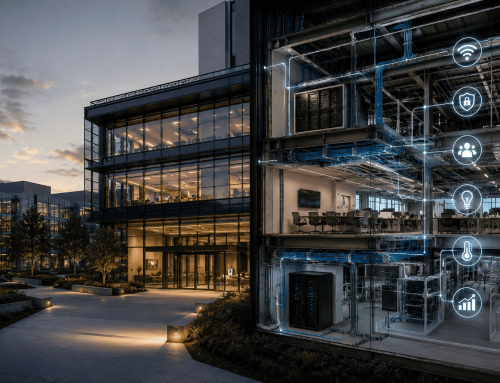
That flexibility extends beyond furniture layouts or modular spaces. It includes the infrastructure hidden behind the walls, the networks supporting every device, and the technology ecosystems that allow new capabilities to be introduced without rebuilding entire environments.
Adaptability begins long before the first employee enters the building.
Designing for a Moving Target
Great workplace design has always required balancing permanence with change.
Architecture provides stability. Technology provides adaptability. Together, they create environments capable of supporting work that has not yet been imagined.
That may be the defining challenge of modern workplace design.
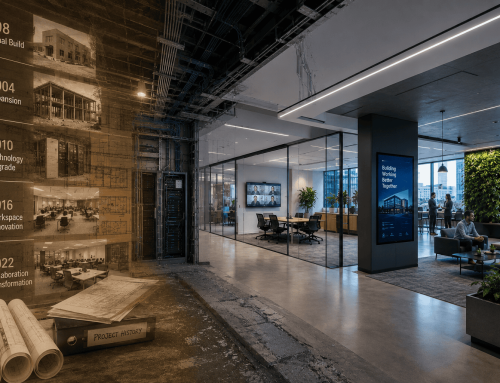
Buildings can no longer be treated as finished products upon completion. They must become platforms capable of evolving alongside the organizations they serve.
At i.e. Smart Systems, we believe the strongest workplaces are those designed not for today’s workflows alone, but for tomorrow’s possibilities. By combining thoughtful technology planning with adaptable infrastructure, organizations create environments that remain valuable long after today’s tools, platforms, and processes have changed.
Because while buildings are designed to last, the work taking place inside them never stops evolving.