Every Building Has a Memory
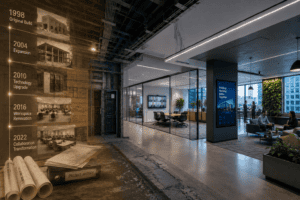
When organizations move into a new building, they often think about what the space will become.
They imagine teams collaborating in conference rooms, clients walking through the lobby, and employees building routines that will shape the culture of the organization for years to come. Every new workplace begins as a blank slate, full of possibility.
What receives far less attention is the fact that buildings accumulate memories.
Not in the sentimental sense, but in the decisions embedded within them. Every renovation, technology upgrade, office expansion, and infrastructure change leaves a lasting imprint. Over time, a workplace becomes a record of the choices an organization has made—some intentional, others reactive.
The question is whether those decisions create a coherent story or a collection of disconnected chapters.
Buildings Remember Every Decision
A workplace rarely changes all at once.
More often, it evolves one project at a time. A conference room is renovated. A floor is reconfigured. Access control is upgraded after a security review. New collaboration technology is installed to support hybrid work. Additional network capacity is added as teams grow.
Each decision solves a real business need, yet few are made in complete isolation. Every project inherits the conditions created by the one before it.
This is why technology planning becomes more challenging as buildings mature. Teams are no longer designing from a blank canvas—they are designing within the context of years of accumulated decisions.
Thoughtful planning acknowledges that history rather than working against it.
The Best Upgrades Respect the Whole System
It is tempting to think of workplace technology as a series of independent projects.
A new meeting room.
A better wireless network.
Updated digital signage.
Viewed individually, these initiatives are valuable. Viewed collectively, they shape the experience of the entire workplace.
The strongest organizations resist the urge to solve each challenge in isolation. Instead, they ask a broader question: How will this decision influence everything that comes next?
That perspective changes the conversation from purchasing equipment to building continuity.
Technology becomes less about individual installations and more about creating an environment that remains coherent as it evolves.
Continuity Is Easy to Overlook
When technology works well, continuity is almost invisible.
Employees move effortlessly between meeting spaces because every room feels familiar. Visitors navigate the building without confusion. New locations reflect the same standards as existing ones. IT teams spend less time supporting exceptions because fewer exceptions exist.
None of these outcomes happen by accident.
They emerge from organizations that think beyond the immediate project and consider how today’s decisions will affect tomorrow’s workplace.
Consistency, in this sense, is not about uniformity. It is about preserving an experience that remains intuitive as the organization grows.
Designing a Legacy
Every workplace is a long-term investment.
Long after the original project team has moved on, the building continues serving new employees, new leaders, and new business priorities. The infrastructure installed today becomes the foundation upon which future decisions will be made.
That is why the most valuable technology investments are rarely those with the longest feature lists.
They are the ones that leave future teams with more possibilities instead of more limitations.
At i.e. Smart Systems, we believe workplace technology should create continuity, not complexity. By planning with the future in mind, organizations build environments that remain cohesive through years of growth, innovation, and change.
Because every building tells a story.
The best ones tell a story of thoughtful decisions that continue making the next decision easier.