Good Buildings Age Well
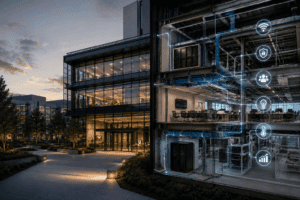
There is a common misconception that the best commercial buildings are the newest ones.
Walk through a recently completed headquarters, a modern healthcare facility, or a state-of-the-art corporate campus, and it is easy to understand why. Contemporary architecture is impressive. Technology feels seamless. Every surface appears intentional.
Yet time has a way of revealing the true quality of a building.
Five years after opening, does it still support the way people work? Ten years later, can it accommodate new technologies without extensive renovation? When the organization grows, does the building evolve with it—or begin resisting change?
The buildings that stand the test of time rarely do so because they were filled with the newest technology. They endure because they were designed with adaptability in mind.
In many ways, the measure of a successful workplace is not how impressive it feels on opening day. It is how well it performs years later, after countless meetings, renovations, software updates, organizational changes, and evolving employee expectations.
Time Is the Ultimate Design Review
Every technology decision creates a future.
A conference room designed around today’s collaboration platform will eventually support something different. Access control systems will receive new capabilities. Network demands will continue increasing. Artificial intelligence will reshape workplace software in ways that are difficult to predict today.
None of these changes are surprising. They are inevitable.
The question is whether the infrastructure beneath them was designed to accommodate change or simply to satisfy the immediate project requirements.
Buildings that age well embrace uncertainty. They acknowledge that tomorrow’s needs will not perfectly resemble today’s, and they create room for that reality.
Adaptability Is an Investment, Not an Expense
Designing for flexibility often requires decisions that appear invisible when a project is complete.
Additional conduit capacity.
Accessible cable pathways.
Equipment rooms with room to grow.
Infrastructure standards that simplify future upgrades rather than complicate them.
These investments rarely appear in marketing photographs, yet they often determine whether future improvements become straightforward projects or expensive renovations.
Good infrastructure quietly protects future budgets by making tomorrow’s technology easier to implement than today’s.
A Workplace Should Improve With Time
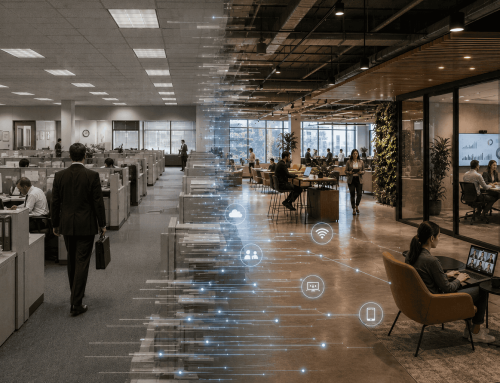
Some environments become increasingly difficult to manage as they mature. Technology accumulates without a clear strategy. Individual upgrades solve immediate problems while introducing new complexity. Support becomes reactive instead of intentional.
Others evolve differently.
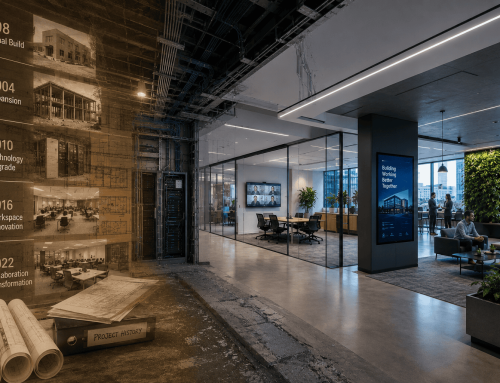
New systems integrate naturally with existing infrastructure. Meeting spaces remain familiar even as technology changes. Growth feels like an extension of the original design rather than a series of disconnected projects.
Those workplaces do not resist change.
They welcome it.
That difference is rarely accidental.
It reflects decisions made long before employees ever occupied the building.
Building for the Next Decade
Perhaps the greatest compliment a workplace can receive is not that it looked modern when it opened, but that it continues feeling relevant years later.
Technology will continue evolving. Work itself will continue changing. Organizations will pursue new strategies that nobody can fully predict today.
Buildings prepared for that uncertainty become lasting assets rather than recurring renovation projects.
At i.e. Smart Systems, we believe the strongest workplace technology strategies are those that anticipate change instead of reacting to it. Our role is not simply to deliver systems that perform well today, but to help organizations create environments capable of supporting whatever comes next.
Because truly exceptional buildings do not remain valuable by standing still.
They remain valuable because they were designed to grow.