The Best Technology Is the Technology You Never Think About
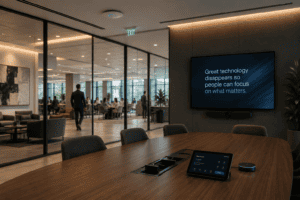
There is an interesting paradox at the heart of workplace technology.
Organizations invest significant time and resources into designing conference rooms, upgrading networks, modernizing security systems, and improving collaboration spaces. Yet if those investments are successful, the technology itself rarely becomes the focus.
Instead, people simply get to work.
Meetings begin without troubleshooting. Visitors move naturally through the building. Employees connect to presentations without asking for help. Security works quietly in the background. Wireless coverage feels ubiquitous because no one has to think about it.
In other words, the greatest measure of workplace technology is often its absence from everyday conversation.
This stands in stark contrast to how technology is frequently discussed. Product announcements celebrate new features. Marketing campaigns highlight specifications and capabilities. Organizations compare platforms, devices, and performance metrics.
Those conversations are important, but they can unintentionally shift attention away from the people the technology is meant to serve.
Technology should not become the experience.
It should enable the experience.
Invisible by Design
Good design often disappears.
Few people notice automatic doors until they fail to open. Climate control becomes obvious only when a room is too hot or too cold. Reliable lighting receives little praise because it consistently performs as expected.
The same principle applies to workplace technology.
The most effective environments feel intuitive because every interaction has been carefully considered long before anyone enters the room. Employees are not thinking about audio processors, wireless access points, or structured cabling. They are thinking about their presentation, their client meeting, or the conversation they are about to have.
That is exactly as it should be.
The role of infrastructure is not to demand attention. It is to quietly remove obstacles so people can focus on more meaningful work.
Simplicity Is Often the Hardest Goal
There is a temptation to equate sophistication with complexity.
In reality, the opposite is frequently true.
Creating a workplace that feels effortless requires extraordinary coordination. Architects, contractors, technology consultants, facilities teams, and IT professionals must make hundreds of decisions that most employees will never notice.
Pathways must be planned before walls are finished. Systems must communicate with one another without introducing friction. Future growth must be anticipated before the building is occupied.
The result is an environment that appears simple precisely because so much thought went into making it that way.
Measuring Success Differently
Organizations often evaluate workplace technology through equipment lists or implementation milestones.
Those metrics certainly matter.
But perhaps the more meaningful questions are these:
Do meetings begin on time?
Can employees move naturally between spaces?
Does the workplace encourage collaboration rather than interrupt it?
Do visitors leave with confidence in the organization they just experienced?
When the answers are consistently yes, technology has accomplished something far more valuable than simply functioning.
It has become part of an environment that allows people to do their best work without distraction.
Beyond the Installation
Technology projects eventually end.
Buildings, however, continue evolving.
Employees change. Business priorities shift. New tools emerge. Expectations continue rising.
The workplaces that remain successful are rarely those with the longest equipment lists. They are the ones where technology quietly adapts alongside the organization, supporting change without becoming the center of attention.
At i.e. Smart Systems, we believe workplace technology is at its best when people barely notice it. Our goal is not simply to install systems. It is to create environments where technology feels natural, dependable, and seamlessly woven into the experience of work itself.
Because when technology fades into the background, people move to the foreground.