The Workplace Is Becoming a Product
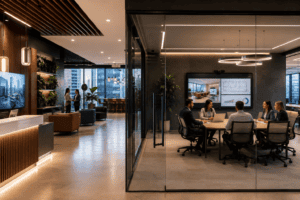
For much of the last century, the workplace was viewed as a physical necessity. It provided employees with desks, conference rooms, and the tools required to complete their work. Success was measured by efficiency—how many people the space could accommodate, how quickly teams could communicate, and how effectively operations could be managed.
Today, that perspective is changing.
Organizations are beginning to recognize that the workplace is no longer just where work happens. It is an experience that influences productivity, collaboration, culture, and even the perception of the company itself. In many ways, the office has become something employees interact with in the same way they interact with a digital product: they expect it to be intuitive, responsive, and thoughtfully designed.
This shift represents more than a change in office design. It reflects a broader change in expectations. Employees have grown accustomed to technology that feels effortless. The applications they use every day require little explanation. Their favorite consumer products anticipate their needs rather than forcing them to adapt. Increasingly, those same expectations are shaping how people judge the environments in which they work.
The modern workplace is no longer competing with yesterday’s office. It is competing with every seamless digital experience people encounter throughout their day.
Every Interaction Shapes the Experience
When organizations discuss workplace technology, the conversation often revolves around individual systems. Access control. Audio-visual equipment. Wireless networks. Room scheduling. Digital signage.
Yet employees rarely experience these technologies independently. They experience the workplace as a continuous journey.
That journey begins long before the first meeting of the day. It starts when an employee enters the building, moves through security, finds an available workspace, connects to the network, joins a meeting, collaborates with colleagues, and transitions between spaces without interruption. Each interaction contributes to an overall impression of whether the workplace feels effortless or unnecessarily complicated.
This is remarkably similar to the way successful digital products are designed. Product designers do not optimize individual screens in isolation; they consider the entire user journey. Every interaction is expected to feel connected to the one before it.
The workplace deserves the same level of intentionality.
Technology Should Support Behavior, Not Demand It
One of the most common mistakes organizations make is selecting technology based primarily on features rather than human behavior.
A conference room may include sophisticated collaboration tools, intelligent cameras, wireless presentation systems, and advanced control interfaces. On paper, the room appears impressive. In practice, however, employees may still struggle to begin a meeting without assistance.
The issue is rarely a lack of capability. More often, it is a lack of alignment between the technology and the people expected to use it.
Good design asks a different question. Instead of asking what technology can do, it asks what people are trying to accomplish and removes unnecessary obstacles from that process.
The difference may seem subtle, but it fundamentally changes how workplace technology is planned. The objective shifts from deploying more systems to creating experiences that feel natural from the first interaction.
Consistency Creates Confidence
Anyone who has worked in multiple office locations has likely experienced an unexpected form of friction: every room works differently.
A display connects one way in the executive boardroom, another in a training room, and differently again in a small huddle space. Security procedures vary between offices. Visitor check-in changes from location to location. Employees spend valuable time learning environments that should already feel familiar.
Product designers understand that consistency builds trust. Once users learn how one part of a product functions, they expect that knowledge to apply everywhere else.
The same principle applies to physical workplaces.
Consistency does not require every room to look identical, nor does it limit innovation. Rather, it establishes a familiar framework that allows people to focus on their work instead of relearning their environment every time they change locations.
For organizations operating across multiple offices, that consistency becomes even more valuable. It reduces support requests, simplifies training, and creates a workplace experience that reflects a cohesive organizational identity rather than a collection of disconnected technology decisions.
The Workplace Is an Expression of the Brand
Companies invest heavily in the design of their websites, customer portals, and digital products because they understand that every interaction communicates something about their brand.
The physical workplace deserves the same consideration.
Clients notice how easily they navigate a building. New employees form opinions about an organization during their first week. Business partners experience meeting spaces before they experience presentations. These seemingly ordinary interactions quietly shape perceptions of professionalism, preparedness, and attention to detail.
Technology plays an important role in that story—not because it should draw attention to itself, but because it should make every interaction feel intentional.
When the workplace functions seamlessly, confidence grows almost invisibly. Employees collaborate more naturally. Visitors leave with a stronger impression. The environment itself reinforces the values the organization hopes to communicate.
Designing Experiences, Not Just Spaces
The workplaces that will define the next decade are unlikely to be distinguished by the number of displays they contain or the sophistication of their hardware. They will be remembered for something far more difficult to measure: how they make people feel while they work.
Technology will always remain an essential part of modern business, but its greatest value lies in how effectively it supports human experience. The most successful organizations will not simply install better systems. They will design environments where architecture, infrastructure, and technology work together so seamlessly that employees rarely think about any of them at all.
At i.e. Smart Systems, we believe the future of workplace technology is not about adding more devices. It is about designing experiences that are intuitive, consistent, and built around the people who use them every day.
Because the most effective workplace is no longer just a place to work.
It is a product—one that should be designed with the same care, purpose, and attention to detail as any experience your organization delivers.