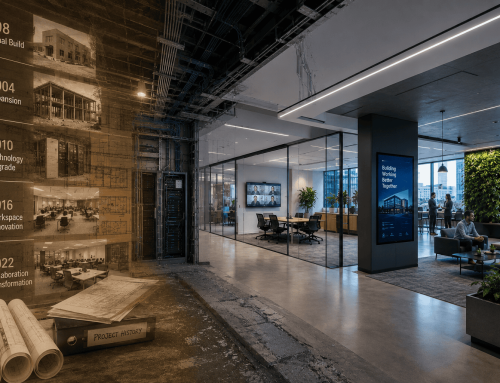
Future-Proof Technology Infrastructure Without Overbuilding

Every organization building or renovating a commercial space faces the same dilemma: build for today and risk falling behind, or build for everything and spend far more than necessary.
Most understand that what they build today needs to support tomorrow’s demands — but predicting those demands with precision is nearly impossible.
As a result, projects often swing in one of two directions. Some teams design strictly for current needs, only to revisit infrastructure far sooner than expected. Others attempt to plan for every possible scenario, investing heavily in capacity and systems that may never be fully utilized.
Future-proofing is not about guessing the future correctly. It’s about building infrastructure that can adapt — without requiring unnecessary cost or complexity upfront.
The Real Cost of Underbuilding
Infrastructure decisions tend to fade into the background once a building is complete. Systems come online, operations begin, and everything appears to function as expected. The problems typically emerge later — when the building needs to do more than it was originally designed for.
A network infrastructure designed for 50 devices that now supports 200 — including IoT sensors, wireless access points, and video conferencing systems — is a common example of underbuilding that looks invisible on day one but becomes operationally disruptive within a few years.
Underbuilt infrastructure creates constraints that are difficult to overcome without disruption. As new technologies are introduced or as usage patterns shift, limitations in cabling pathways, network capacity, or system integration begin to surface. What initially seemed like a cost-saving decision turns into a long-term liability.
In many cases, addressing these limitations requires reopening walls, rerouting pathways, or replacing foundational components. These are not minor adjustments — they are costly, time-consuming efforts that interrupt normal operations and strain internal resources.
The challenge is not that the original system failed. It’s that it was never designed to evolve.
Why Overbuilding Isn’t the Answer
Overbuilding is often seen as the safer alternative. If underbuilding creates risk, the logic follows that adding more capacity, more systems, and more redundancy upfront should eliminate it.
In practice, this approach introduces a different set of problems.
Excess infrastructure that isn’t tied to a clear operational need can increase both capital costs and long-term complexity. Systems that are never fully utilized still require maintenance, documentation, and oversight. Over time, this can create environments where teams are managing more than they actually need — without a corresponding increase in performance or flexibility.
There is also a strategic risk in overcommitting to specific technologies too early. When infrastructure is built around assumptions that don’t materialize, organizations can find themselves locked into systems that no longer align with how the building is used.
Future-proofing should not be confused with over-specifying. The goal is not to build everything — it’s to build intelligently.
Designing for Scalability Instead of Capacity
The most effective way to balance these risks is to shift the focus from capacity to scalability.
Capacity answers the question: “How much do we need today?” Scalability answers: “How easily can we expand tomorrow?”
Scalable infrastructure is designed to grow incrementally. Instead of installing maximum capacity upfront, it provides the pathways, space, and flexibility required to add capacity when it’s actually needed.
This can take several forms in a commercial environment. Pathways and conduit can be sized to accommodate future cabling without requiring structural changes. Equipment rooms can be planned with enough space and power to support additional systems later. Network architecture can be designed with headroom that allows for expansion without requiring a full redesign.
These decisions are often subtle during construction, but they have a significant impact on how easily a building can adapt over time.
Planning for Flexibility, Not Specific Technologies
One of the most common mistakes in future-proofing is trying to plan for specific technologies that may or may not become relevant.
Technology evolves quickly. Platforms change, standards shift, and new systems emerge that weren’t part of the original plan. Attempting to predict these changes too precisely can lead to infrastructure that is overly rigid or misaligned with actual future needs.
A more effective approach is to design for flexibility.
Flexible infrastructure supports a range of potential technologies without being tied to any single one. This includes using open standards, avoiding proprietary limitations where possible, and designing layouts that allow spaces to be reconfigured without significant rework. Structured cabling built to current standards like Cat6A, for example, supports today’s needs while accommodating higher-bandwidth applications that may not yet be commonplace — without requiring a full recabling project down the road.
Flexibility also extends to how spaces are used. Conference rooms, collaborative areas, and workspaces are rarely static. Infrastructure that can support changing layouts and use cases allows organizations to evolve without revisiting core systems.
In this sense, future-proofing is less about predicting the future and more about removing barriers to change.
The Role of Standardization in Long-Term Adaptability
Standardization plays a critical role in making future growth manageable.
Without consistent standards, every expansion or upgrade becomes a one-off decision. Systems are evaluated individually, documentation varies, and implementation approaches differ from one project to the next. This creates friction that slows down progress and increases the likelihood of errors.
With standardization, organizations create a repeatable framework for how infrastructure is designed and deployed. This framework doesn’t eliminate flexibility — it provides a controlled environment where flexibility can exist without introducing chaos.
As new technologies are adopted or as additional locations are developed, standardized infrastructure allows teams to move faster and with greater confidence. Decisions are informed by proven approaches rather than starting from scratch each time.
Over time, this consistency becomes one of the most valuable aspects of a future-proof strategy.
Visibility Enables Smarter Decisions Over Time
Future-proofing is not a one-time decision made during design and construction. It’s an ongoing process that continues throughout the life of the building.
The ability to adapt effectively depends on visibility — understanding how systems are performing, where capacity is being used, and where potential constraints are developing. Without this level of insight, infrastructure planning becomes reactive. Teams respond to problems after they’ve already impacted operations, rather than addressing them before they surface.
When organizations have access to real-time performance data, they can make informed decisions about when and how to expand infrastructure. Upgrades can be planned proactively rather than reactively, reducing disruption and improving overall system reliability.
Without visibility, future-proofing becomes guesswork. With it, infrastructure evolves based on actual needs.
A Practical Approach to Future-Proofing
Future-proofing is often misunderstood as doing more upfront. In reality, it’s about doing the right things at the right time.
The most effective strategies share a few common principles:
- Build infrastructure that supports current operations reliably
- Create pathways and systems that allow for incremental growth
- Avoid overcommitting to technologies that may not be needed
- Use open standards and avoid proprietary limitations where possible
- Establish standards that make expansion predictable and repeatable
- Maintain visibility into how systems perform over time
When these elements are aligned, infrastructure becomes an asset that supports long-term performance rather than a constraint that limits it.
Building for What’s Next — Without Overbuilding Today
Commercial buildings are expected to support evolving technology, changing work environments, and increasing operational demands. The infrastructure behind those buildings plays a central role in determining how well they adapt.
Future-proofing is not about anticipating every change. It’s about creating the conditions that make change manageable.
At i.e. Smart Systems, we work with organizations to design infrastructure that balances performance, scalability, and practicality — ensuring buildings are prepared for what’s next without introducing unnecessary complexity today.
Evaluating a new build or renovation? Let’s talk about designing infrastructure that’s built to grow. Contact our team to start the conversation.