Why Workplace Technology Expectations Changed Faster Than Most Offices
The average team loses six minutes per meeting to technology friction. Across an organization, that adds up to thousands of hours a year — not from catastrophic failures, but from small moments that compound over time.
Over the last several years, workplace expectations have changed dramatically. Employees now expect seamless wireless connectivity, reliable hybrid meetings, intuitive collaboration tools, flexible workspaces, and technology experiences that function consistently across locations.
The challenge is that many office environments were never designed to support these expectations.
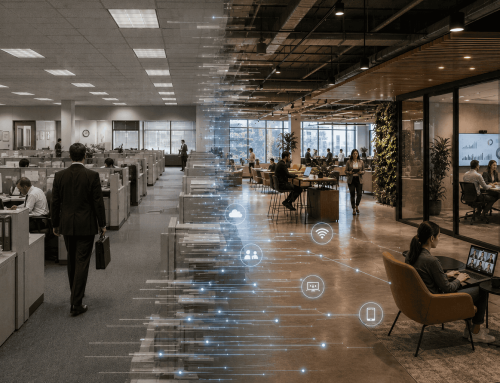
In many organizations, workplace technology evolved incrementally rather than strategically. New platforms were added, meeting rooms were upgraded, collaboration tools were layered into existing environments, and hybrid work became part of daily operations — often without the infrastructure changes needed to support those shifts effectively.
As a result, many workplaces now operate in a constant state of adaptation, where technology exists everywhere but still creates friction for the people using it.
The Workplace Has Changed Faster Than Infrastructure
The modern office no longer functions the way it did even five years ago.
Conference rooms are expected to support hybrid collaboration by default. Employees move between desks, offices, and remote environments throughout the week. Meetings involve multiple platforms, devices, and participation styles simultaneously.
At the same time, expectations around speed and reliability have increased significantly. Employees expect workplace technology to function with the same level of simplicity they experience in consumer technology environments.
But unlike consumer technology, commercial environments depend on layers of infrastructure that cannot evolve overnight.
Many buildings still rely on:
- Outdated cabling pathways
- Inconsistent wireless coverage
- Legacy AV systems
- Fragmented room standards
- Infrastructure that was never designed for current bandwidth and collaboration demands
The result is a growing disconnect between how employees expect spaces to function and how those spaces were originally designed.
Friction Shows Up in Small Moments
Most workplace technology frustrations are not catastrophic failures.
They appear in small moments that slowly impact productivity over time:
- Meetings starting late
- Unreliable wireless connectivity
- Inconsistent room experiences
- Difficulty sharing content
- Audio quality problems during hybrid calls
- Rooms that require support intervention too often
Individually, these issues may seem minor. Collectively, they shape how employees experience the workplace every day.
When technology consistently creates friction, it changes how people use spaces. Employees begin avoiding certain rooms, bypassing systems, or relying on personal workarounds instead of the intended environment.
Over time, this reduces adoption, decreases operational efficiency, and limits the value organizations expect from their workplace technology investments.
Hybrid Work Exposed Existing Weaknesses
Hybrid work did not create most workplace technology issues — it exposed them.
Many offices were originally designed around in-person collaboration, where technology played a supporting role rather than serving as the primary connection point between distributed teams.
By 2026, an estimated 40% of all office interactions involve at least one remote participant — meaning that every meeting room is now, in effect, a hybrid meeting room. Infrastructure that wasn’t designed for that reality shows the strain quickly.
Once hybrid meetings became standard, weaknesses in room acoustics, camera positioning, network performance, and collaboration workflows became much more visible. Spaces that functioned adequately before suddenly struggled under new expectations.
This shift forced organizations to rethink not just individual systems, but the broader relationship between infrastructure, collaboration, and employee experience.
Simplicity Has Become More Important Than Features
One of the biggest changes in workplace technology is the growing importance of usability.
Organizations are no longer evaluating systems solely based on feature lists. Increasingly, they are prioritizing:
- Consistency
- Reliability
- Intuitive user experiences
- Operational simplicity
The most successful workplace environments are often the ones where technology feels invisible — where employees can focus on collaboration instead of troubleshooting the room around them. If the technology isn’t invisible, it’s in the way.
Achieving that level of simplicity requires intentional planning behind the scenes:
- Infrastructure alignment
- Standardized room logic
- Thoughtful AV integration
- Reliable network performance
- Long-term operational support
Without those elements, even advanced systems can create frustrating experiences.
The Workplace Experience Is Now Part of Infrastructure Strategy
Technology is no longer separate from workplace experience. The two are increasingly connected.
Employees evaluate workplaces not only by aesthetics or location, but by how effectively spaces support communication, collaboration, and day-to-day productivity. In 2026, workplace experience has also become a talent issue — candidates increasingly filter opportunities based on flexibility and how well an organization’s environment supports the way they work. Organizations that can’t deliver a seamless, reliable experience risk losing access to the talent they need.
This means infrastructure decisions now directly influence:
- Employee experience and retention
- Operational efficiency
- Workplace flexibility
- Long-term adaptability
Organizations that approach workplace technology strategically are better positioned to support evolving work models without constantly reacting to operational friction.
Designing Workplaces for How People Work Today
Modern workplace expectations will continue evolving, and commercial environments must evolve alongside them.
At i.e. Smart Systems, we help organizations design technology environments that support modern collaboration, operational reliability, and long-term flexibility — creating workplaces that function more effectively for the people using them every day.
Because the modern workplace is no longer defined only by physical space. It’s defined by how seamlessly people can work within it.
Ready to close the gap between how your workplace was designed and how people actually work today? Contact our team to start the conversation.