Are Your Offices Emergency-Ready with the Right Smart Building Systems?
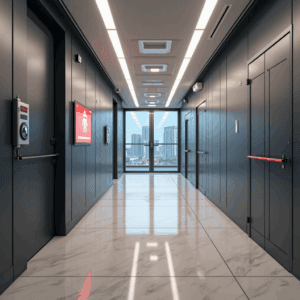
When an emergency strikes—whether it is a fire, medical incident, security threat, or extreme weather—speed and coordination are critical. Today’s emergency preparedness strategies must go beyond printed floor plans or isolated alarm systems. Smart building systems offer a more dynamic and responsive approach, integrating technologies like automated lighting, environmental sensors, surveillance, and mass notification tools. These systems are not only designed to improve daily efficiency but are also built to enhance life safety during critical events. In emergency scenarios, they transform passive infrastructure into active support systems that assist in decision-making and immediate response.
The Challenge: Traditional Systems Cannot Keep Up in a Crisis
Many organizations still rely on outdated emergency protocols that function in isolation. A fire alarm may sound, but ventilation systems may continue running, and employees may be left unsure of what to do next. While 76% of American employees believe their workplace is prepared for an emergency, more than one in three report that their employer has no emergency response plan at all (source: https://www.fusionrm.com/blogs/american-and-international-companies-preparing-for-emergencies). This disconnect between perception and reality can have serious consequences when a crisis unfolds. Without integrated building systems—like automated lighting, environmental controls, and centralized communication—emergency responses are often delayed, disjointed, or dangerously unclear. Smart infrastructure bridges these gaps with automation and coordinated control that supports faster, safer outcomes.
Smart Systems in Action: Building Automation That Responds
Smart building technology addresses these challenges through system-wide integration and automation. Sensors placed throughout the facility can detect anomalies such as gas leaks, rising heat, water intrusion, or even motion in restricted areas. These sensors communicate instantly with building management platforms to initiate actions like shutting off HVAC circulation, locking down specific areas, or activating emergency lighting paths. Security cameras equipped with AI analytics can identify unusual behaviors and trigger alerts in real time. Mass notification systems can deliver targeted messages to employees through mobile devices, overhead speakers, and digital signage, helping guide people to safety with clarity. Rather than acting in isolation, these systems function as a cohesive unit that supports informed, immediate action.
i.e.Smart Systems: Your Partner in Emergency-Ready Infrastructure
At i.e.Smart Systems, we help clients create office environments that are not only intelligent but also crisis-capable. Our approach begins with a thorough understanding of your facility’s emergency response needs and ends with the delivery of an integrated system that brings all critical functions together. We design and implement solutions that tie lighting controls, environmental monitoring, video surveillance, access control, and alert systems into one responsive platform. This unified infrastructure helps your team react quickly and precisely when it counts. From initiating lockdowns and guiding evacuations to triggering automated building adjustments during environmental hazards, i.e.Smart Systems ensures your workspace is fully prepared to respond. With our team’s technical expertise and deep understanding of emergency protocols, we deliver safety solutions that are as intelligent as they are reliable.
About i.e.Smart Systems
i.e.Smart Systems is a Houston, TX based technology integration partner that specializes in design and installation of audio/visual technology and structured cabling. For more than three decades, our team of in-house experts has partnered with business owners, architectural firms, general contractors, construction managers, real estate developers, and designers in the Houston market, to deliver reliable, scalable solutions that align with their unique goals.