The Rise of the Multi-Purpose Workplace
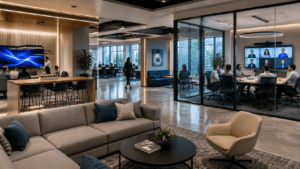
For decades, workplace design followed a relatively predictable formula.
Organizations built offices around assigned workstations, conference rooms, executive offices, and a handful of shared spaces. Each area served a specific purpose, and employees moved through the environment in a fairly structured way.
Today’s workplace looks very different.
A single space may need to support a client presentation in the morning, a hybrid team meeting in the afternoon, and an internal company event later that evening. Employees move between focused work, collaboration, virtual meetings, and informal conversations throughout the day. Teams expect flexibility, and organizations expect their real estate investments to work harder than ever before.
As workplace expectations continue evolving, offices are increasingly being designed around adaptability rather than permanence.
This shift has given rise to the multi-purpose workplace.
Flexibility Has Become a Business Requirement
The modern workplace is no longer designed around a single way of working.
Organizations are balancing hybrid schedules, changing team structures, fluctuating occupancy levels, and evolving employee expectations. As a result, spaces that were once dedicated to a single function often need to support multiple activities throughout the day.
A large conference room may double as a training space. An open collaboration area may host presentations, team meetings, or company gatherings. Shared workspaces may accommodate employees from multiple departments on different schedules.
The goal is no longer to maximize square footage. It’s to maximize the usefulness of the space.
For many organizations, flexibility has become a competitive advantage—not only from an operational perspective, but also in how they attract and retain talent.
Technology Is What Makes Flexibility Possible
While furniture and architecture often receive the most attention, technology is what allows a space to adapt.
Without the right infrastructure, multi-purpose environments can quickly become frustrating to use.
Employees expect to walk into a room and connect instantly. Teams expect displays, cameras, audio systems, and collaboration platforms to work together seamlessly. Visitors expect presentations to start without technical delays. Leadership expects spaces to support a variety of business functions without requiring constant reconfiguration.
Meeting those expectations requires thoughtful integration behind the scenes.
Network infrastructure, wireless connectivity, AV systems, room controls, digital signage, and collaboration tools all play a role in creating spaces that can shift between different uses without disrupting the user experience.
The most successful environments make that complexity invisible.
The Workplace Is Becoming More Dynamic
One of the biggest changes in office design is the move away from rigid space definitions.
Rather than creating rooms with a single purpose, organizations are increasingly designing environments that can evolve alongside changing needs.
A collaboration area may support:
- team brainstorming sessions
- client meetings
- virtual presentations
- training workshops
- company events
The physical space remains the same, but the technology enables different experiences depending on how the room is being used.
This approach helps organizations extract more value from existing real estate while creating environments that feel more responsive to the needs of employees.
User Experience Matters More Than Ever
Flexibility only creates value when spaces remain easy to use.
If employees need extensive training to operate a room, or if support teams are constantly troubleshooting technology issues, the intended benefits of flexibility begin to disappear.
This is where many organizations struggle.
As more capabilities are added to a space, complexity often increases as well. Multiple platforms, inconsistent room configurations, and disconnected systems can quickly create friction for users.
The most effective multi-purpose environments prioritize simplicity. Employees should be able to focus on their work—not on figuring out how the room operates.
When technology feels intuitive, adoption increases and organizations see a stronger return on their workplace investments.
Designing for Change Instead of Predicting It
One of the biggest challenges in workplace planning is that no organization can fully predict how work will evolve over the next five or ten years.
Business priorities change. Team structures shift. New technologies emerge. Workplace expectations continue to evolve.
The organizations that adapt most successfully are not necessarily the ones that predict every change correctly. They are the ones that build environments capable of accommodating change when it happens.
This requires infrastructure that is scalable, flexible, and designed with future growth in mind.
Rather than creating spaces optimized for a single moment in time, organizations are increasingly investing in environments that can evolve alongside the business itself.
The Future Workplace Is Defined by Adaptability
The rise of the multi-purpose workplace reflects a broader shift in how organizations think about space.
Success is no longer measured by how many offices, desks, or conference rooms a building contains. It is measured by how effectively those spaces support the people using them.
At i.e. Smart Systems, we help organizations create workplace environments that combine flexibility, reliability, and intuitive technology—ensuring spaces can support today’s needs while remaining ready for tomorrow’s opportunities.
Because the most valuable workplace is no longer the one built for a single purpose.
It’s the one prepared for whatever comes next.