Reliability Is the Most Underrated Feature in Workplace Technology
In workplace technology, innovation tends to get the attention.
Organizations invest in smarter meeting platforms, advanced access control, workplace analytics, cloud-connected AV systems, and increasingly integrated building environments. New features are launched constantly. New hardware enters the market every year. Technology conversations often center around what is next.
But despite all of that innovation, one of the most important measures of a successful workplace technology environment remains surprisingly simple:
Does it work — every time someone needs it to?
Employees are interrupted by technology problems an average of 3.6 times per month — each one costing at least 15 minutes of productive time. That’s not a feature problem. That’s a reliability problem.
Reliability may not be the most exciting part of workplace technology, but it is often the part people remember most. Because when technology works consistently, people stay focused on their work. When it doesn’t, the disruption is immediate.
Reliability Shapes the Everyday Workplace Experience
Most employees will never think about structured cabling pathways, signal routing, equipment racks, or backend system configuration.
What they notice is whether they can walk into a room and start a meeting without delay.
They notice whether guest access works on the first try. Whether the display connects. Whether audio is clear. Whether badge access responds immediately. Whether shared spaces feel intuitive to use.
These moments may seem small, but together they define the workplace experience.
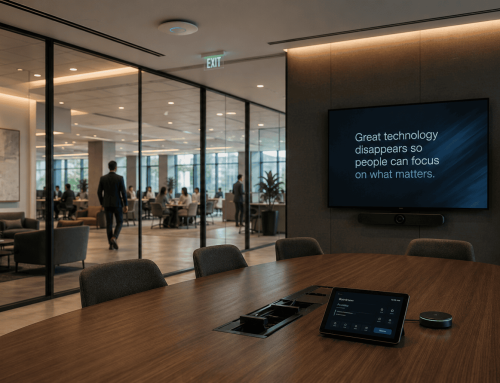
When systems are reliable, technology fades into the background. People move through the day without interruption.
When systems are inconsistent, even minor issues begin creating friction: meetings start late, support tickets increase, users lose confidence, and teams begin relying on workarounds instead of the systems designed to support them.
Over time, those moments add up — and nearly two in three office workers say negative experiences with workplace technology affect their mood and engagement at work.
Reliability Is More Than Equipment Performance
Reliability is often mistaken for hardware quality alone.
But in commercial environments, reliable performance depends on much more than the equipment itself. It depends on how systems were planned, integrated, installed, and supported over time.
A well-designed technology environment requires coordination between multiple layers: network infrastructure, cabling, power, AV systems, security platforms, software interfaces, room design, and operational workflows.
When any of those layers are disconnected, reliability becomes harder to maintain.
Two buildings can use identical equipment and produce completely different user experiences — because reliability is determined by how intentionally all of those layers were designed to work together, not by the spec sheet of any single component.
The Most Advanced System Isn’t Always the Best System
Workplace technology conversations often focus on capabilities — how many features a platform has, how advanced the interface looks, how many integrations are possible.
But feature-rich technology does not automatically create a better workplace experience. In many cases, complexity becomes the problem.
A room with ten features that employees struggle to use often delivers less value than a room with fewer features that works flawlessly every time.
Reliability builds trust. And trust drives adoption.
When employees trust the technology in a space, they use it more confidently. Meetings begin faster. Fewer support calls are made. Collaboration feels easier. Systems become part of the workflow rather than a barrier to it.
That consistency often creates more value than adding another layer of functionality.
Reliability Reduces Operational Noise
Employees with poor-performing technology lose over two hours per week compared to just 30 minutes for those with high-performing systems — a gap that compounds quickly across teams and locations.
For IT teams, facilities leaders, and operations teams, reliability means fewer recurring issues competing for attention. It means:
- Fewer service calls
- Less reactive troubleshooting
- Fewer repeated room failures
- More predictable maintenance
- Stronger long-term system performance
- Better scalability across locations
Instead of constantly fixing the same issues, internal teams can focus on larger priorities.
This operational stability becomes especially important in multi-site organizations, where inconsistency across environments can quickly multiply support demands.
Reliable systems create operational breathing room.
Reliability Has Become a Strategic Advantage
As workplaces become more connected, expectations continue rising.
Employees expect workplace technology to feel seamless. Leadership expects investments to last. IT teams expect environments to be manageable. Organizations expect spaces to support collaboration without interruption.
Meeting those expectations consistently requires more than innovation. It requires dependable infrastructure and thoughtful execution behind the scenes.
Reliability may not always be the most visible part of workplace technology — but it is often what determines whether the experience succeeds.
And increasingly, that makes it one of the most valuable features a workplace can offer.
Built to Perform Over Time
At i.e. Smart Systems, we believe the strongest technology environments are not simply the most advanced — they’re the most dependable.
We work with organizations to design, build, and support workplace technology systems that perform reliably over time, helping teams create spaces that feel intuitive, consistent, and ready for the demands of everyday use.
Because in workplace technology, reliability isn’t a small detail. It’s the foundation everything else depends on.
Want to evaluate how your workplace technology is performing? Contact our team to start the conversation.